I will explain how Gen X is different to Gen Snowflake.
This blog is a comparison of Roleplaying THEN and Roleplaying NOW.
I have kept this 'nice' and Safe-For-Work to avoid my getting banned off the internet.
Roleplaying Then
"You wake up with a gun in your hand wearing combat flaks."
Roll a D10 to see if your transport is intact. Pass.
"Some dude says "go!". You find yourself kicked in the ass out of a helicopter and falling. Around you there are explosions going off. The sound of the helicopter, explosions and distant gunfire from the ground below drowns out all other noise."
Roll a D10 to see if you are hit by a bullet. Pass.
"Overhead there are several more helicopters, at least one of which is exploding, its carcass falling to the floor in flames with men jumping out if they can. Around you are men also dressed in combat gear, some falling, some drifting on parachutes. Most of them are alive but some have been killed already by bullets being fired upward from the ground. You realise you have a parachute, and somehow find your way to pull the rip cord."
Roll a D10 to see if your parachute works. Pass.
"You drift to the ground."
Roll a D10 to see if it is Urban or Jungle (discretionary).
Roll a D10 to see if your parachute gets snagged on a tree or a building before you hit the ground. Pass.
Roll a D10 to see if you break your leg on landing. Pass.
Roll a D10 to see if you land surrounded by enemies or away from any immediate combat (discretionary).
At this time someone asks "what game are we playing?" to which the Gamesmaster replies "It's not a game. its a cope test."
Yeah, that was the eighties.
Improvised roleplaying game scenarios. You had around five seconds to reply or the GamesMaster would move onto the next thing already.
"While you are standing around being indecisive an enraged jaguar jumps at you with its claws out. What do you do?"
"Did you mention I was holding a gun?"
"Yes."
"Am I still holding a gun?"
Roll a D10. Pass. "Yes."
"I shoot the jaguar before it mawls me!"
Roll a D10 to see if your gun jams. Pass.
"The jaguar lands crumpled by your feet, dead. The sound of your machine gun fire draws attention to you."
Roll a D10 to see if enemy combatants approach immediately. Pass.
"You hear voices shouting in a foreign language, approaching your position. What do you want to do?"
"Hide."
"Where?"
"Climb a tree."
"You still have parachute strapped to your back. Climbing a tree is very difficult. The parachute is snagging onto something on the ground."
"I take off my backpack!"
"While you are detaching your backpack, enemy soldiers appear and shoot at you."
Roll a D10 to see if you get hit. Fail.
You are dead.
GAME OVER
RESTART
"You are falling from a helicopter. Around you are explosions."
Roll a D10 to see if you are wearing a parachute (Restart Penalty)
Roleplaying Now
Communication Tools (also called Safety Tools)
They are discussed in "Session 0" (a pre-game meeting) and can be adjusted anytime.
These are standard practices in tabletop role-playing games (TTRPGs). They help the group agree on tone, content, and boundaries before and during play. The goal is to make sure everyone feels safe and respected, especially when the game involves heavy themes like violence, trauma, addiction, betrayal, or horror.
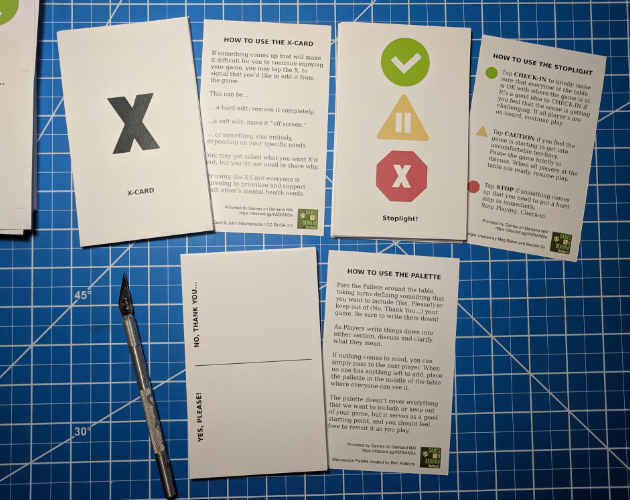
X-Card
The X-Card is one of the simplest and most widely used safety tools. It was created by John Stavropoulos.
How it works: A physical card (or digital equivalent) with a big "X" on it is placed in the middle of the table (or a signal like crossing your arms in an X is agreed upon).
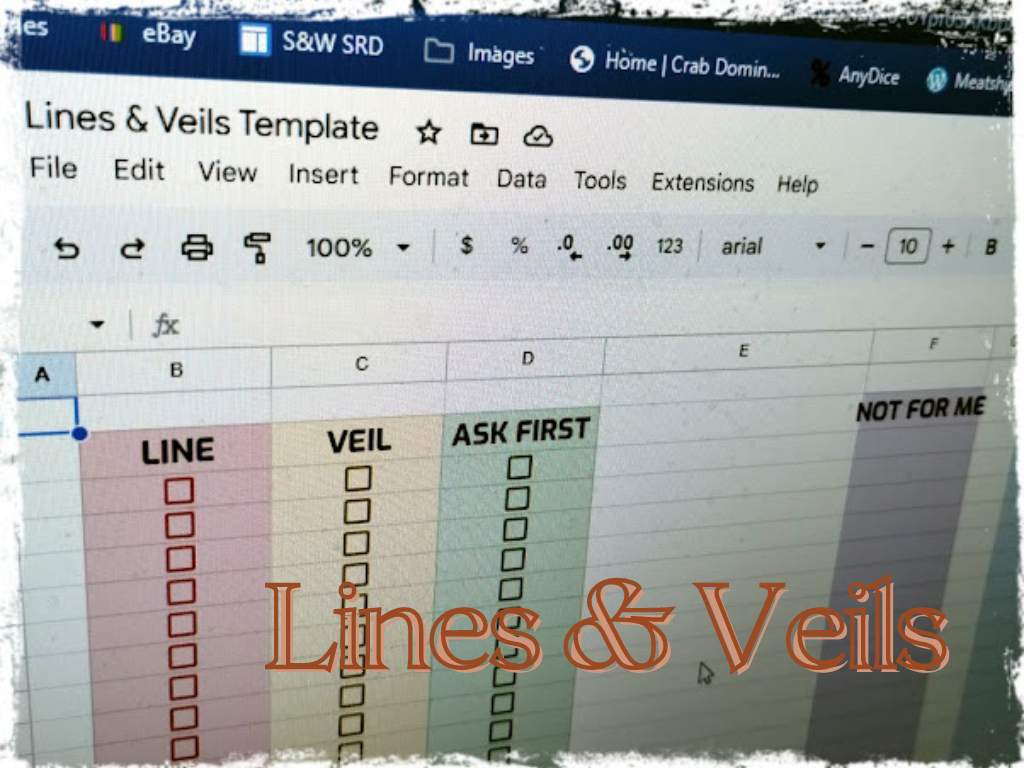
Lines and Veils
Lines and Veils is a more structured way to set boundaries at the start of the game. It was popularized by Ron Edwards and refined by many others.
Lines (hard limits): Topics or content that are completely off-limits and should never appear in the game. These are absolute "no"s. Examples: graphic depictions of sexual assault, harm to children, animal cruelty, or real-world slurs. If something crosses a Line, the group avoids it entirely.
Palette Grid (by Jay Dragon)
The Palette Grid is a more nuanced safety tool created by game designer Jay Dragon (Possum Creek Games). It was made as an upgrade to Lines & Veils for groups who want to explore intense topics deliberately rather than just avoiding them.
How it works: You create a 2x2 grid (or larger) with two axes:
One axis: Risky vs. Comfortable (how emotionally charged or potentially distressing a topic feels).
These tools are all free and easy to find online (search the names + "TTRPG" or "safety tools"). Many groups mix them.
e.g., use Lines & Veils in Session 0 and keep an X-Card out during play, then reference the Palette Grid for deeper themes. The key is that they're collaborative and can evolve as the group gets to know each other better.
Gritty Realism
Quite honestly, if I had any inclination to suggest such a thing to any of my oldschool and regular players, they would tell me I'm taking the piss and find themselves a new GamesMaster.
Next Up: Anyone for a quick game of The Sickest Witch ?